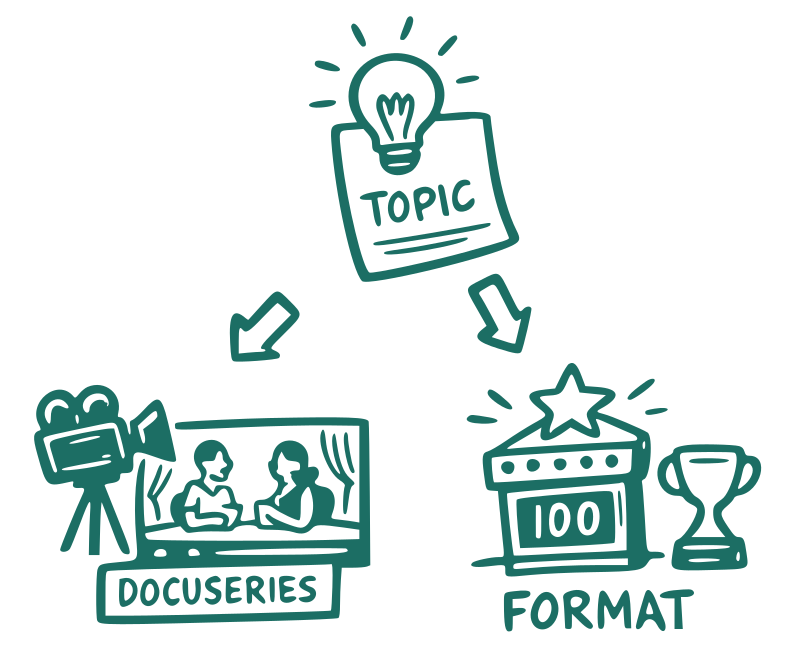





Some unscripted ideas are driven by people. Some are driven by a world. Some are driven by a structure. Some are driven by a mix, which is where the label can get fuzzy.
That label matters because a format and a docuseries are not pitched the same way.
A docuseries pitch usually has to show real people, real access, a specific world, and story that can unfold over time. A format pitch has to show the design of the show: what repeats, who participates, what choices are created, and why the setup can keep working.
Neither lane is better. But if you pitch one like the other, the idea can get harder to understand than it needs to be. And reality TV pitches already have enough ways to confuse people without help.
What is the basic difference?
A format is driven by structure and can often work with new contestants, couples, families, homes, clients, cases, challenges, or locations. The cast may change because the structure is the main thing holding the show together.
A docuseries is driven by people, access, world, and unfolding story, and usually depends more on the specific people or world you are following. If you remove the central family, workplace, expert, community, or access, the show may no longer exist in the same way.
Here is the simplest test: If the setup can work with new people, it may be a format. If the idea depends on these specific people or this specific world, it may be a docuseries.
When your idea is probably a docuseries
Your idea is probably a docuseries if the main value comes from the people, world, relationships, or access you already have.
A docuseries might follow a family business, unusual workplace, closed community, high-pressure profession, expert practice, small town, social circle, team, subculture, or person at a turning point. The pitch should make a producer understand why this real world is worth entering.
For a docuseries, the key questions are:
- Who are we following?
- Why are they watchable?
- What do they want?
- What pressure are they under?
- What access do you actually have?
- What could unfold over a season?
A docuseries is not just “interesting people exist.” Interesting people are helpful, but the pitch still needs direction. A producer should understand what viewers will watch happen, not just that the people are colorful, funny, dramatic, inspiring, or “perfect for TV.”
That last phrase gets used a lot. Usually by someone’s aunt. Sometimes the aunt is right. The pitch still needs specifics.
When your idea is probably a format
Your idea is probably a format if the main value comes from the setup.
A format might be a competition, dating show, game show, transformation series, social experiment, challenge show, lifestyle format, or hybrid. It has a design that can keep working with new participants or new situations.
For a format, the key questions are:
- Who participates?
- What do they have to do?
- What shapes the experience?
- What creates pressure?
- How does a typical episode end?
- Can the same setup work again?
A format pitch cannot rely only on a clever hook. The hook may get attention, but the design has to hold the show together after the first sentence.
“People trade lives” is a hook. “Two families swap homes, budgets, and routines for five days, then decide which changes they will keep” is closer to a format. Now there is a setup, time frame, action, and result.
When your idea is a hybrid
Many unscripted shows are not purely one thing.
A workplace show might be a docuseries because the staff, business, and relationships are the main draw. But it may also have a repeatable case-of-the-week rhythm.
A transformation show may depend on a host or expert, but each episode still follows a process from problem to reveal.
A dating show may have a structured process while also depending heavily on real chemistry and cast.
The question is not, “Can this only be one thing?” The better question is: What is doing the main work?
If the specific people and access are the reason to watch, lead with that. If the structure is the reason the show repeats, lead with the format. If both matter, explain the balance.
A hybrid pitch often needs one clear lead sentence:
This is a workplace docuseries with a repeatable client-of-the-week structure.
Or:
This is a transformation format built around a specific expert and their unusual access.
That kind of sentence tells the reader how to evaluate the idea.
The people test
Ask what happens if you replace the people.
If the show loses most of its value, you may have a docuseries. For example, a show about one chaotic family running a roadside zoo depends on that family, that business, that history, and that access. A different family in a different zoo might not create the same show.
If the show can continue with new people because the setup still works, you may have a format. For example, a show where different families compete to redesign a neglected room each episode is less dependent on one family. The design can repeat.
This does not mean docuseries cannot have structure. They should. It means the people and world are carrying more of the value.
The access test
Ask what you actually have.
If you have attached talent, a real family, an unusual workplace, a closed community, a rare location, expert access, existing footage, or permission to film somewhere specific, your idea may be stronger as a docuseries or access-driven show.
This is especially important for first-time creators. A docuseries pitch with real people, visuals, and access can be easier to evaluate than a format pitch that depends on untested mechanics. A producer can look at the people, world, and footage and decide whether there is something there.
A format pitch often asks the reader to believe the structure will work. That is possible, but it puts more pressure on the rules, casting logic, and execution.
So if your strongest asset is real access, do not bury it under a complicated format just because “format” sounds more official.
The episode three test
Ask what episode three looks like.
If episode three follows the same structure with new participants, cases, challenges, dates, clients, or reveals, you may have a format.
If episode three depends on what happens next in the lives of your cast, you may have a docuseries.
For example:
Format-shaped: Each episode, a different family gives full control of the household to the youngest member for 72 hours.
Docuseries-shaped: We follow one family as their youngest member pushes for change while the older generation fights to keep control.
Both could be interesting. They just need different pitches.
The format version needs to explain the setup, participants, episode path, and result. The docuseries version needs to explain the family, access, relationships, stakes, and season direction.
How the pitch changes
Once you know the lane, the pitch gets easier to shape.
If you are pitching a docuseries, bring forward the real-world material: people, access, setting, relationships, pressure, season direction, visual proof, and why this story is worth following now.
If you are pitching a format, bring forward the design: setup, participants, process, stakes, episode shape, ending, and why the structure can work again.
If you are pitching a hybrid, explain which part leads.
The label should help the pitch. It should not become a cage. Nobody is handing out trophies for categorizing perfectly. The goal is to make the idea easier to understand.
Common format vs. docuseries mistakes
Mistake 1: Calling every idea a format
A topic, cast, or world is not automatically a format. A format needs a setup that can work again.
Mistake 2: Hiding real access behind rules
If your strongest asset is a real family, workplace, location, or expert, do not bury that under unnecessary mechanics.
Mistake 3: Pitching a docuseries with no story direction
A docuseries does not need format rules, but it still needs pressure, relationships, stakes, and season potential.
Mistake 4: Pitching a format with no design
A format cannot rely only on a clever hook. The pitch should show what happens, who participates, and how episodes end.
Mistake 5: Treating hybrid as an excuse to be vague
A hybrid can work, but the pitch still needs to explain what is driving the show: people, world, access, structure, or some combination.
The right label helps the reader understand what kind of show they are evaluating. It also helps you decide what materials matter most.
Your deliverable: a format-or-docuseries check
Before you build your pitch materials, test which lane your idea belongs in.
- Does the idea depend on specific people, talent, world, or access?
- Would the show still work with a different cast?
- What repeats from episode to episode or season to season?
- Is the main draw the world and unfolding story?
- Is the main draw the setup and structure?
- Do I have real access, visuals, footage, or attached people?
- Can I explain what episode three looks like?
- Would this be stronger as a docuseries, format, or hybrid?
- Which part should lead the pitch?
- What materials best support that lane?
If the answer is still unclear, that is useful. It may mean you are trying to pitch two versions at once. Choose the version that is easiest to understand and strongest to support.
How this helps on Showrilly
When you publish a concept on Showrilly, choosing the right show type helps the page make more sense.
A docuseries concept page should bring forward people, access, world, relationships, story direction, and available materials. A format concept page should make the structure, participants, stakes, episode path, and ending easier to find.
If your idea is a hybrid, the page can still work. Just make the lead clear. Is someone reviewing a people and access show with some structure, or a structured format with a strong real world element?
That small distinction can save a lot of guessing. And guessing is not usually where a pitch gets stronger.