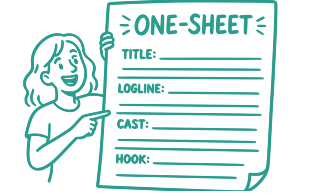





A reality TV pitch deck is a visual document that helps producers understand your unscripted show idea. It usually includes the title, logline, concept, show type, cast or characters, access, episode structure, tone, visual references, and a few reasons why the project feels timely or worth developing.
A pitch deck is not the same as a one-sheet or a sizzle reel. A one-sheet gives someone the quick version. A sizzle reel gives them a feel for the people, world, tone, or access. A pitch deck gives them the fuller case for the show: what it is, why it works, who is in it, how episodes unfold, and why the concept can keep going.
For a first-time creator, the deck does not need to look like a finished network presentation. It needs to be clear. A producer should be able to read it and understand the show without you standing there to explain every page.
That goal is easy to forget. Many pitch decks are not weak because the idea is bad. They are weak because the deck makes the idea harder to understand.
Before you design, make sure the idea is ready
Do not start with fonts, colors, or image boards. Start with the show.
If the idea itself is still vague, a deck will usually make that problem more visible. You can spend days making pages look polished, but if the show is unclear, the deck will still feel unfinished.
Before you build the deck, make sure you can answer a few basic questions:
- What is the show?
- Who is in it?
- Why are they worth watching?
- What happens in a typical episode?
- What changes over the season?
- What kind of buyer would understand this idea?
- Why does it feel relevant now?
If those answers are still fuzzy, the deck will not fix them. It will just make the confusion look more designed.
A pitch deck should organize your thinking. It should not be where you discover the show for the first time.
The 4 things your pitch deck has to prove
A reality TV pitch deck does not need to prove that the show will sell. No pitch material can do that. But it does need to make the idea easier for a producer to evaluate. Most strong decks prove four things.
1. A clear show, not just a topic
A topic is not enough. “Extreme weddings,” “small-town doctors,” “teen entrepreneurs,” or “family restaurants” may be interesting areas, but they are not automatically shows.
A pitch deck has to explain the specific version of that world: who we follow, what they want, what pressure they are under, and what we watch happen.
A deck should help a producer move from “I understand the subject” to “I understand the show.”
2. People or access worth watching
Reality TV depends on people, access, or both.
If your show is character-driven, the deck needs to make the people feel specific. Not just “funny,” “bold,” or “dramatic,” but specific in the way real people are specific: what they want, what they are up against, what relationships matter, and why viewers would want to spend time with them.
If your show is access-driven, the deck needs to explain what access you have and why it matters. A rare location, closed world, unusual workplace, attached talent, expert relationship, or real permission to film can make a pitch much stronger.
A producer should not have to guess whether the people or world are real.
3. A repeatable episode shape
Even a loose docuseries needs a sense of shape. A buyer wants to know what a typical episode might feel like.
Does each episode follow a case, client, challenge, event, transformation, investigation, performance, trip, build, date, or decision? Does the season follow a larger arc? Are there milestones or turning points?
You do not need to write every episode before you pitch. But if a producer cannot imagine what Episode 3 looks like, the idea may feel underdeveloped.
The deck should give just enough structure to show that the series can continue.
4. A realistic way to make the show
Some ideas sound exciting until the production reality becomes obvious.
If the show depends on celebrity access you do not have, legal permissions you cannot get, unsafe filming conditions, expensive travel, unclear rights, or locations you cannot enter, the deck should not pretend those issues do not exist.
That does not mean you need to solve every production question. It means you should be honest about what you have, what you control, and what would need to be developed with a producer.
A realistic pitch is usually stronger than a giant pitch built on assumptions.
What should a reality TV pitch deck include?
There is no single required format, but most strong unscripted pitch decks answer the same questions in roughly the same order. The deck should move from quick understanding to deeper detail. Do not bury the basic idea on page six.
1. Title page
Start with the title, a simple visual direction, and your name or company name.
The title page should set the tone without making the reader work too hard. If the show is warm, funny, tense, glossy, gritty, strange, emotional, or aspirational, the design can begin to suggest that. But clarity matters more than decoration.
2. Logline
The logline should explain the show in one sharp sentence.
A strong reality TV logline usually includes the people or world, the situation, and the reason we keep watching. If the logline is vague, the rest of the deck has to work harder than it should.
3. Short overview
The overview gives the reader the clean version of the show.
This is usually one to three short paragraphs. Explain what the series is, who or what it follows, what happens, and why the idea has enough life for multiple episodes or a full season.
Do not turn the overview into a mission statement. Producers need to understand what viewers will actually watch.
4. Show type
Name the kind of unscripted show you are pitching.
Is it a docuseries, documentary series, lifestyle format, competition format, dating format, social experiment, workplace series, talent-led show, transformation series, or hybrid?
This helps the reader understand how to evaluate the project. A character-driven docuseries and a competition format are not judged the same way.
5. The world or access
Explain where the show lives and what makes that world worth entering.
This could be a workplace, family business, community, location, subculture, industry, expert practice, social circle, or closed environment. If you have real access, say so clearly. If there are visuals, relationships, permissions, or existing materials that help prove the access, mention them.
For many first-time creators, access is one of the most valuable things in the pitch. It gives a producer something concrete to evaluate.
6. Cast, characters, or talent
Introduce the people who drive the show. For a docuseries or character-driven concept, this section may be one of the most important parts of the deck.
Include short descriptions that explain who each person is, what they want, what makes them watchable, and how they relate to the others.
For a host-led or expert-led show, explain the person’s authority, personality, audience, skill, or access. Do not just list credentials. Explain why they belong on screen.
For a format without attached cast, describe the casting world. Who participates? What kinds of people make the format work? What range of characters or personalities would the show need?
7. Episode structure
Explain what happens in a typical episode.
This section does not need to be complicated. It can be a short paragraph, a simple episode flow, or a few beats that show how an episode begins, builds, and resolves.
For example, a transformation show may move from problem to plan to process to reveal. A workplace docuseries may move between client cases, staff relationships, and larger business pressure. A competition format may move through challenge, judging, elimination, and consequences.
The point is not to lock every beat forever. The point is to help a producer see the shape of the show.
8. Season arc or sample episodes
Give the reader a sense of where the series can go.
For a docuseries, this may include season-long questions, relationship arcs, business stakes, personal goals, or major events. For a format, this may include sample episodes, challenge ideas, themes, casting variations, or ways the structure can repeat.
Sample episode ideas should be specific enough to feel real, but not so detailed that they slow down the deck.
9. Tone and visual style
Help the reader understand how the show feels.
Is it warm and funny? High-pressure and emotional? Glossy and aspirational? Raw and intimate? Fast, noisy, and competitive? Quiet and observational?
Use visual references when they help. Images can clarify world, tone, location, style, and personality. But do not let the mood board replace the actual pitch. A beautiful deck with unclear storytelling is still unclear.
10. Comparable shows
Use comps to help the reader place the idea.
Good comparable shows explain tone, audience, structure, buyer lane, or production scale. They are not there to say, “This will be the next huge hit.” They are there to help someone understand how your show might live in the unscripted space.
It is usually stronger to include two or three thoughtful comps than a long list of famous shows.
11. Why now
Explain why the idea feels timely.
This does not have to mean the show is about a trend. The timing may come from cultural conversation, audience behavior, a growing subculture, a changing industry, a new kind of talent, or access that is available now.
“Why now” should make the project feel alive, not forced.
12. Production notes or available materials
If relevant, include a short section on what already exists.
This might include attached cast, signed access, a location relationship, visual materials, a sizzle reel, a casting tape, archival footage, expert relationships, proof-of-authorship records, or other materials that could help a producer understand the project.
Keep this section practical. You are not trying to prove that the show is already produced. You are showing what is real and what can be reviewed.
13. Creator information
End with a short creator bio and contact or submission information.
This should not take over the deck. Give the reader enough to understand who you are, why you are connected to the project, and how to reach you or review additional materials.
How long should a reality TV pitch deck be?
For most unscripted pitches, aim for 10 to 20 slides. That range is not a rule. Some concepts need fewer pages, and some need more.
A character-driven docuseries with several cast members may need more room than a simple lifestyle format. A competition format may need extra space to explain rules and episode flow.
Still, if your deck is drifting past 25 or 30 pages, ask what is truly helping the reader. A producer may not have time to study a long document before they understand the basic show.
A good pitch deck should feel complete, not crowded.
Design rules for non-designers
You do not need to be a professional designer to make a professional-looking pitch deck. You do need restraint.
Use one clean visual style. Avoid too many fonts, colors, image treatments, borders, backgrounds, or decorative elements. The design should help the reader understand the idea, not compete with it.
Leave white space. Use short paragraphs. Break up dense pages. Make headings clear. Keep images relevant.
If the show has real visual material, use it. Actual locations, people, settings, objects, events, or behind-the-scenes images can be more useful than generic stock photos. But only use images you have the right to use, and do not rely on visuals to explain what the words should explain.
The best pitch deck design usually feels simple, intentional, and easy to read.
Common reality TV pitch deck mistakes
Mistake 1: Starting with too much background
A producer does not need the full history of the subject before they understand the show. Start with the concept, then add context where it helps.
Mistake 2: Making the deck too long
A deck should give enough information to understand the project, not every thought you have had about it. Too many pages can make the idea feel less focused.
Mistake 3: Designing around mood instead of clarity
Visuals matter, but they should support the pitch. A beautiful deck that does not explain the show is still a weak deck.
Mistake 4: Leaving out the episode structure
Even a character-driven docuseries needs a sense of how episodes unfold. Producers should not have to invent the shape of the series for you.
Mistake 5: Treating the deck like a finished series bible
A pitch deck is a development tool. It should be clear and persuasive, but it does not need to solve every creative, casting, legal, or production question.
The best decks leave a producer with fewer questions about the basics. They know what the show is, who or what gives it life, how episodes work, and what materials are available if they want to look further.
Your deliverable: a deck outline
Before you design the full deck, create a simple outline. Do this in a plain document first. No images. No fonts. No colors. Just the pages, in order. Here’s a checklist:
- Title page
- Logline
- Short overview
- Show type
- Why now
- World or access
- Main cast, characters, or talent
- Episode structure
- Season arc or sample episodes
- Tone and visual references
- Comparable shows
- Production notes or available materials
- Creator information
- Contact or submission details
Once the outline is clear, the design decisions get easier. If the outline is confusing, the finished deck probably will be too.
How this helps on Showrilly
When a producer opens your Showrilly concept page, they are not trying to admire a document. They are trying to understand the show.
A strong pitch deck gives them a fuller place to go after the logline, one-sheet, or short concept description. It can explain the cast, world, access, episode structure, tone, and materials in a way that is too detailed for the top of the page.
Your deck does not need to answer every possible question. It should make the first read easier: What is this? Who is in it? Why does it keep going? What makes it different from shows already on the air?
The clearer the deck is, the less a producer has to guess. And guessing is usually where a pitch starts to lose momentum.
Showrilly gives you one place to organize your pitch materials, publish a clear concept page, and make the deck easier for verified producers to review if they want the fuller version. It does not guarantee producer interest, but it can help your pitch feel less scattered when someone does take a look. A one-sheet for a reality TV pitch and a clear decision about whether you need a sizzle reel to pitch a reality TV show can support the deck.